Saturday, June 20, 2015

Pursue High-Speed Rail Project under Public Private Partnership Scheme

A high-speed rail (HSR) linking Kuala Lumpur (KL), the capital of Malaysia and Singapore was proposed by private sector both in the 1990s and year 2006 but was shelved due to high cost.

The HSR can reduce the travel time between KL and Singapore to 90 minutes and will bring huge economic and social benefits to both countries.  In year 2013, both governments agreed to cooperate and share the huge investment required for the HSR project.

The HSR project could be developed as a public-private partnership (PPP) scheme to tap the private fund and gain the efficiency of private sector.


-          What is the infrastructure problem that the PPP is trying to solve?
-          Currently, the KL – Spore route is serviced by 3 main modes of transport: air, road and an existing intercity rail network. The travel time between the two neighbours is about four hours by car.
-          According to Malaysia’s Land Public Transport Commission (SPAD), there is a need to improve connectivity between the two countries. The currently traffic congestion is acute and the capacity of the Causeway has exceeded 33%.
-          The HSR project cannot be fully funded by either government or private sector alone due to its huge upfront capex and long gestation period. Realistically, a substantial amount of government assistance is required in the form of either soft loans or grants.
Source: SPAD


-          What services are to be provided and are these services affordable?
-          It will greatly reduce the travel time between the two neighbours to 90 minutes from about four hours by car.
-          HSR is an efficient and safe mode of transport.
-          The HSR project does not only transporting people but also act as an economic catalyst to further develop and spur new modern townships and economic activities along the lines that will cross towns in southern part of peninsular Malaysia .

 
Source: SPAD


-          What are the reasons that the private sector would want to participate?
-          PPP would enable the private partner to capture the benefit of the ‘whole-life’ approach to operation and maintenance
-          PPP scheme enables long-term profitable concession thus garners local and international interest. The routes relevant for the Southern Corridor HSR saw strong growth with the total travel market growing from 5.47 million passenger-km in 2005 to 7.45 million passenger-km in 2011.
-          The HSR is dubbed as South-East Asia’s most ambitious infrastructure project and the region’s first HSR along a 340km link. Being selected as the private partner in this PPP project would form a good profile for the private parnet for future jobs and tenders.
-          The HSR project has the supports from both private and public sectors because the HSR project is economically sensible and politically acceptable.
-          Private sector with experience in building and operating the HSR line would produce better outputs with broader perspectives toward the project life cycle (LCC). LCC considerations give flexibility to the designer, builder and operator opportunity to be more efficient.
Source: SPAD


-      How should these risks be allocated? Consider the country context in judging the risks and who should take them.

-          The development cost of high-speed rail (HSR) project could possibly be divided between the two governments based on geographical location of the project’s infrastructure, which is reportedly more than RM38bil.
-          As HSR service would be an alternative mode of transportation other than road transport and air transport, using a user-fee PPP would be more appropriate than availability-based PPP.
-          The private party is usually allocated the risk of demand for use of the HSR, in addition to the risks of design, finance, construction, and operation.
-          In view that the HSR project would benefit not only the HSR users but would also contribute to the development of economic and social aspects identified as economically viable, the HSR demand risk may be allocated partially to the public authority that may share the risk by underwriting a minimum level of usage and provide subsidy.
-          long-term risk transfer can be achieved in the PPP structure, especially as to maintenance risk. This is because it may be cheaper for the Design, Build & Operate (DBO) contractor to walk away than to deal with a long-term problem with maintenance costs.
-          because the debt funding is not provided or guaranteed by public-sector, private lender’s discipline over the process is intact
-          construction, completion and maintenance risks remain with the private sector
-          Tapping the private sector’s strengths in securing finance, technical expertise, construction knowhow and operation experience in a PPP project would ensure that specific risks are allocated to those who best handle it.


Tuesday, June 16, 2015

High Speed Rail and Public Private Partnership (PPP)

A high-speed rail (HSR) linking Kuala Lumpur, the capital of Malaysia and Singapore was proposed in the late 1990s but was shelved during the Asian financial crisis due to high cost. In year 2006, private investor began to lobby the two governments, raise funds and plan the project but the Malaysian government halted the project again citing high-costs of over RM 8 billion (US$ 2.5 billion).

The primary objective for the HSR is to reduce the travel time between Kuala Lumpur and Singapore to 90 minutes. The HSR project will bring huge economic and social benefits as well as development potential to both countries.  In year 2013, both Malaysia and Singapore governments agreed to cooperate and share the huge investment required for the HSR project, which is reportedly more than RM 38 billion.

According to Malaysia’s Land Public Transport Commission (SPAD), private participation is expected and that the public-private partnership (PPP) scheme could rely more on government financial support as the development cost is relatively high.

1. Risk allocation
As HSR service would be an alternative mode of transportation other than road transport and air transport, using a user-fee PPP would be more appropriate than availability-based PPP. The private party is usually allocated the risk of demand for use of the HSR, in addition to the risks of design, finance, construction, and operation.
In view that the HSR project would benefit not only the HSR users but would also contribute to the development of economic and social aspects identified as economically viable, the HSR demand risk may be allocated partially to the public authority that may share the risk by underwriting a minimum level of usage and provide subsidy.

2. Successful factor
If PPP approach is opted, HSR project of this size would require huge commitments from the private and public sectors both financially and politically. Tapping the private sector’s strengths in securing finance, technical expertise, construction knowhow and operation experience in a PPP project would ensure that specific risks are allocated to those who best handle it. Different incentive structure in private sector and public sector would generally incentivize the private sector to be more efficient in delivering their service and with higher value for money applicable in PPP.

Although the HSR project has not yet started, the commitment from the government of both countries including the setting-up of Land Public Transport Commission (SPAD) shows that political champion to this PPP project is well secured.

Like other Mass Rapid Transit system currently under the purview of SPAD, it is believe the HSR project would be successfully executed through a transparent and competitive bid process, and well managed with the right mix of global and local experts.

3. Should it be done as PPP?
In my opinion, the HSR project should be done as a PPP. It has the supports from both private and public sectors because the HSR project is economically sensible and politically acceptable. As the government is facing tight fiscal condition that would not allow full public procurement, a PPP approach would be suitable to this HSR project.

PPP would allow private sector player to participate in the design, build, finance, operate and transfer (DBFOT) of the HSR project for real efficiency gains. Private sector with experience in building and operating the HSR line would produce better outputs with broader perspectives toward the project life cycle (LCC). LCC considerations give flexibility to the designer, builder and operator opportunity to be more efficient.


Monday, November 25, 2013

Myanmar Waves


The current version of Lonely Planet (2013) for Myanmar is out of date. The book advised travelers not to change at the airport exchange booth as the official rate is less than a tenth of the black-market rate.

However, this is no longer the case. Now, you can change not only USD, but also Singapore Dollars, Euro, and Japanese Yen at the airport exchange booth with good rates. One thing remain is that your USD bills must be in crunchy or new without folds. USD 100 bill will get a better exchange rates than smaller bills. To-date as in November 2013, USD $1 = Kyat 969 ; SGD $1 = Kyat 774.

I have tried the Myanmar food at good restaurant as well as roadside stalls. Hygiene is an issue here as most of the roadside stalls do not have direct clean water supply but they take it from somewhere else. Thus, the food seller would minimize the water usage and wash the cups and plate in the same container repeatedly. So far, i have only experienced once in which i had one whole day diarrhea after consuming a plate of noodles at a food stall next to a cinema near Park Royal, Yangon.


Looks nice? It caused me farted the whole night and went to toilet first time at 3am in the morning and 2nd at 4am, 3rd at 430am and subsequently the next whole day.


These 3 photos above were taken at Feel Restaurant near Pyidaungzu Yeiktha Street.


Monday, October 17, 2011

Volunteering that Makes Us Smile

Volunteering that Makes Us Smile Know Korea / Know Korea

2011/10/17 09:49

복사http://blog.naver.com/korea_brand/10121582215

Volunteering that Makes Us Smile

It is said that taking care of teeth from your childhood is very important. A recent study shows that taking proper care of teeth prevents the heart disease. The basic is to brush teeth in a proper way and scale teeth on a regular basis. But there are many people who cannot afford it. A charity group has been doing a service for those since long ago.

The joy in Volunteer Work


< Annual meeting for better volunteering> (Source: Yollin Dental Society)

Yollin Dental Society was established in 1999 to volunteer for poor neighbors. It is blowing a fresh breeze into many dentist groups in Korea. The targets are those who abandoned, seniors who live alone, and Korean-Chinese. Well, the Yollin Dental Society is busy enough to go to different places everyday that needs their help.

Then, how do they volunteer? Once the dentist license holder becomes a member of Yollin Dental Society, he gets a volunteer-schedule on a regular basis. Considering his/her schedule, the next step is to apply in advance. It is also good for building friendship among volunteers.

Kim Seong Moon, the newly elected president of Yollin Dental Society, said that the progress of the volunteer group cannot be made by just one or two persons’ efforts. He emphasized that passion and devotion from each person are the keys to achieve the progress and strengthen the friendship among members.

To Abroad!


(Source: Health Korea)

Yeolin dentist group went abroad for a volunteer work for the first time this year. Kim prepared for international volunteer with passion. The original plan was to set up clinics abroad in order to provide Korean medical services for people in developing countries. They are planning another overseas volunteering project on a regular basis in the near future.

The first destination was Indonesia. As it is a first international project, they already conducted a field trip, and did a lot of research. Finally, 25 dentists flew to Indonesia for a volunteer work from 29th of July to the 3rd of August. They treated factory workers and neighbors at factory of Dada Korea in Laya 76 km away from Jakarta. 309 patients were treated through the volunteer work.

Arrived very late, the dentist group set up the equipments until dawn and started to treat patients from the next morning. The situation was not so good. Mostly, they extracted and scaled teeth for local people, which continued for six days. In addition, they did a skin care and nail care for female workers and opened flee market with Korean items they brought from Korea. Of course, it was very popular.


(Source: Asia Economy)

The president of the group said, “More than 700 people wanted to be treated but only 300 people had opportunities due to the schedule. But I’m very glad to get things done without any accident.”

Yollin Dental Society marked 11th anniversary. Two hundred volunteers have treated seven thousand people so far. They have grown up as one of the most famous volunteer groups with six clinics in Korea.

Dental care is very important but it costs a lot of money. Until now, dental care was not affordable to low income class. However, we have Yollin Dental Society, and it seems that they will be the strong supporters.

Tuesday, October 4, 2011

Fall Foliage Trip to the South

Article picked from
http://blog.naver.com/korea_brand/10120391749

Starting from the North to the South, whole place is changing its color as it gets closer to the end of autumn. Autumn leaves turn red when the weather gets cold, so mountainous Gangwon-do become the first place of autumn leaves. When you look down from the sky, leaves descend to the South and finally stop at Jeju island.

Shall we move on to the South?

Foliage Trip to Mt.Palgong

Mt.Palgong, which is located in Daegu, is always popular among many people. You don’t need to spend much time and money to enjoy the autumn leaves. The mountain is said to be the most beautiful in late October.

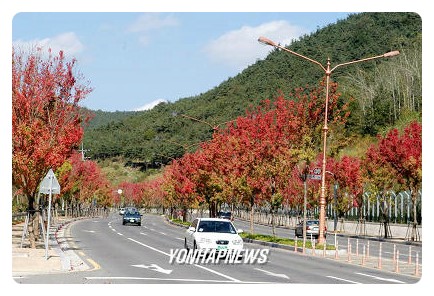
Trip to autumn leaves starts at the entry to the Mt.Palgong. 1,300 gingko trees are lined up along six kilometer long road between Gongsan tunnel and School, which is very popular car driving course. Going down the road after tunnel, you will be amazed at gingko trees. It is fantastic to see golden wave of gingko trees.

When you turn to Dongwha temple at Baekan intersection, you’ll meet the line of gingko trees. After passing by school, you’ll meet maple trees. It is simply beautiful.

Plus, Mt.Palgong belt way is very popular among drivers for the beauty of its maple trees. The whole mountain is full of red color when the fall reaches its peak. You’ll definitely be amazed.


(Source:Yonhap News)

Hiking is the best way to enjoy the autumn of Mt.Palgong. There are many hike ways in the mountain such as Buin temple road, Gatbawi road and Dongwha temple road. Some buddhists pray toward Buddha statue at Gatbawi. This buddha statue was made in Shilla dynasty and became known as praying site for education, health, occupation, and baby boys. Many people come to this site to pray for their own wish every day.

Trekking to the Autumn of Mt.Jiri

Mt.Jiri is the second highest after Mt.Halla of Jeju island. This mountain is huge. There are so many famous and beautiful sites in the mountain. Autumn leaves of this mountain are as beautiful as other mountains.

Autumn leaves start to turn red in late September at Mt.Jiri. It is not well-known but you can enjoy autumn leaves earlier than any others in southern part.

Foliage of Mt.Jiri will start in 5th of October at Cheonwang peak, about 15th at main line, between 20th and 25th at Pia valley and three or four days later than Pia valley at Baemsa valley. If you want to get the most beautiful scenery, you should go up to Cheonwang peak. The most beautiful hike way is between Sesok and Chunwang Peak.

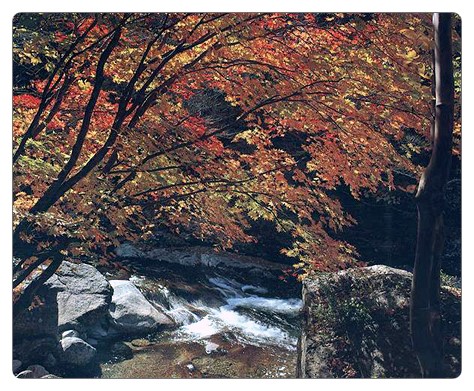
Cho-Sik, a scholar of Joseon dynasty, said “Don’t tell anybody that you’ve seen foliage without seeing the foliage of Pia valley. Foliage of Jikjeon is one of ten beautiful sceneries in Mt.Jiri. Pia Valley is famous for hike way of foliage. Foliage hiking in Pia valley starts at Seongsamjae and continues to Nogodan and descends to Pia valley or moves forward to Baemsa valley. This hike way has so beautiful scenery that many people take this way.

Foliage in Baemsa valley is as beautiful as Pia valley. Pia valley is famous for foliage whereas Baemsa valley is famous for valley itself. Baemsa valley is nine kilometer long and colorful leaves harmonize with that valley. Foliage spreading from Banseon complex to Ganjangso is regarded as the most beautiful scenery in Baemsa valley.


(Source: Korea Tourism Organization)

There are some other foliage sites to see in Mt.Jiri. Various hike ways have been developed since long time ago. Shall we take a trip to Mt.Jiri?

Mt.Dyuryun, the Harmony of a thousand years history and the beauty of the Mountain

Duryun mountain, which is located at the southernmost peninsula, is full of evergreen broadleaf and deciduous broadleaf. There are some national treasures such as Daedun temple, Pyochung temple, the bell of Tapsan temple and so on.

Duryun mountain is well known for camelia and foliage. The valley is two kilometers long from the group facilities complex to the temple. The latest foliage, regarded as one of the most beautiful autumn scenery, can be seen there.


(Source:Daeheung Temple Wesite)

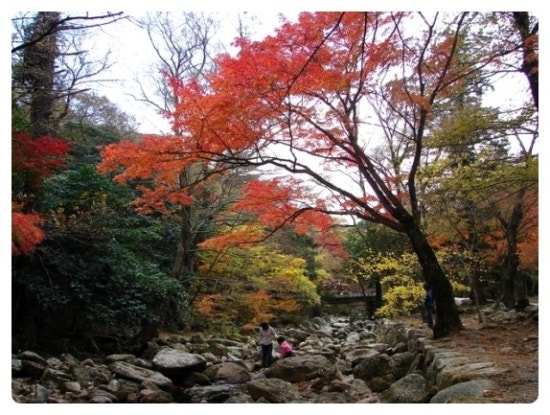
The best scenery of this mountain is a maple tree forest of the way to Daehung temple. Take a walk through the temple gate. You’ll refresh yourself. Maple forests and camellia can be seen. Trees are like tunnel. When you cross a bridge, there is tunnel of maple trees.

Let’s walk through the yellow and red gingko trees and maple forest and keep going up along the car road. Mountain is covered up with yellow and red wave. Crossing valley and bridge, you’ll meet Youseondang and backdrop of foliage which are the highlight of the journey. The last of the journey is the road up to Daehung temple.

Maple Leaves of Mt.Halla, the Southernmost of Korea

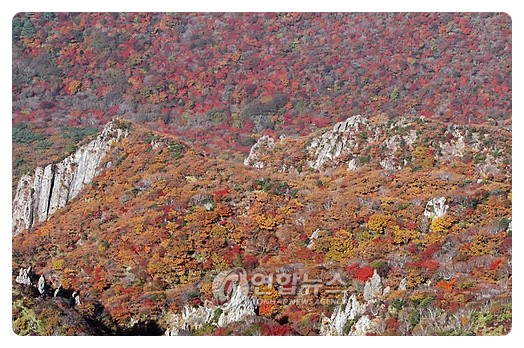
Foliage of Mt.Halla in Jeju island is not as well known as other sites. The famous sites are Wanggwanneung, Mansae hill, road between Youngsil rest area and Byeongpung rock area, road 1100 and 516. In particular, uniquely shaped 500 rock pillars stand at Youngsil rest area and Byeongpung rock area. The area is probably the most beautiful site.

Youngsil of Mt.Hallan is easy to access for all walks of life. Youngsil course starts at pavilion. Road to Youngsil is flat, however, the pine trees and maple forests along the road will lead you to the unique landscape. Walking a little further up, you can have good scenery of foliage. Maple forest starting under the Byeongpung rocks continues to gate of the hike way. It is magnificent.

Another joy of Jeju trip. If you have a plan to go to Mt.Halla, do not miss autumn foliage in Youngsil.


(Source: Yonhap News)

How was the journey? Autumn is right at the corner. Shall we take a walk and breathe in the forest of autumn foliage?

Learning Strong Wisdom of Sea Women in Jeju Island

Article picked from http://blog.daum.net/korea_brand/1424

Learning Strong Wisdom of Sea Women in Jeju Island

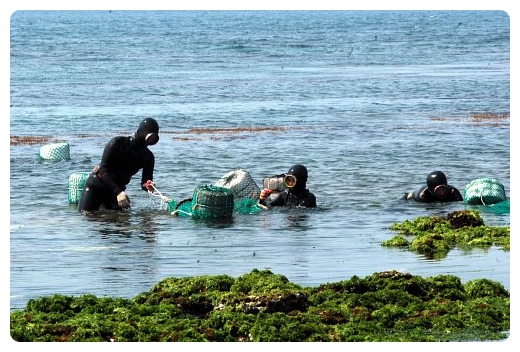
Ocean of Jeju island has Mt.Halla and hundreds of parasitic volcanoes. In addition, the ocean has sea women who represent strength. Sea women are the past and future of Jeju island. Ocean is their life and they have struggled over hundreds of years. Let’s learn who they are.

Catch A Glimpse of History and Footstep of Sea Women

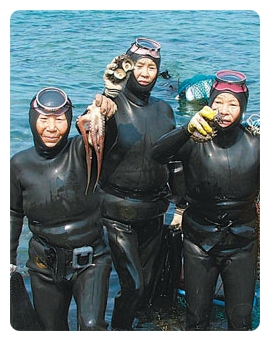
Sea women may be only in Korea and Japan. Most of Korean sea women live in Jeju island, estimated about 20,000. We assume that the origin of sea women started at prehistoric era when human sought their food in the sea, considering that the shrine for fishermen and sea women existed from ancient times. But most of all, Jeju island is believed to be a birthplace of sea women.

(Source: Local Segye Shinmun)

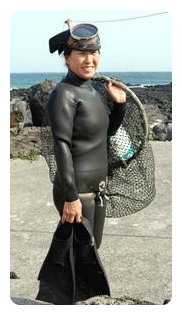
Jeju women have been destined to swim in the sea unless they did not farm in the field. Girls started to swim at the age of seven and eight. When they were seventeen and eighteen they became sea women. Their prime time last until 40.

They usually work five meters under the sea for 30 seconds but if necessary, they dive 20 meters and endure for two minutes under the sea. Whenever they come up to the surface, they breathe out deeply. In addition, they join community gathering and organizing sea women’s club or diver’s club. By these activities they decide diving time, diving manner and joint collection and carry out on their own. They contribute to prosperity of villages by joint raise and joint collection of sea food.

They dive 20 meters under the sea and endure two minutes long and swim in the cold winter. They have extraordinary skill and spirit. They dive even after giving a birth. There is a folk song, ‘Song of Sea women’, showing determination of sea women of Jeju island.

Meet Sea Women in a Variety of Way

It’s not easy to see them even though we often heard that they have strong spirit and wisdom. Fortunately, the Jeju city government hosts a festival and opens a museum to promote sea women. The festival started first at 2002 world cup season. There are a variety of programs showing a myth of Jeju, life of sea women and life of fishing village. During the festival, many events are presented such as photo gallery painting contest, food court, and fireworks in order to promote sea women.

(Source: Korea Tourism Organization)

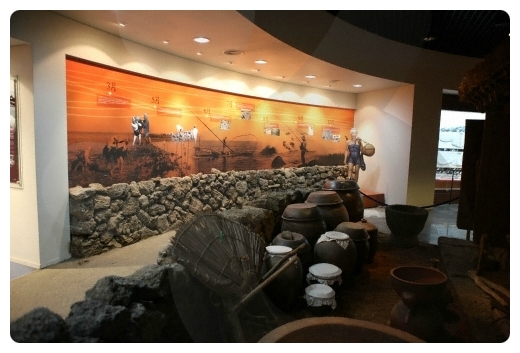
Sea women museum displays the history and work of sea women and the tools of collecting sea food. Four story museums have three exhibit rooms, video room, observatory, and children hall. The first exhibit room reproduces sea women’s house, fishing village, shamanism and seasonal customs. The second exhibit room is made of workplace of sea women. The third exhibit room has fishery of ancient times, sea of hope for better understanding of fishing village and culture. Museum is the place for children education.

Movement to Preserve Sea Woman

Sea women would disappear if the seniors stop diving. Jeju University and other Korean research centers claim that sea women should be designated as the living culture heritage. Central government and local government need to work hard on the matter.

(Source:Donga Ilbo)


Jeju sea women are very rare so city government is trying to list them as the world cultural heritage. Because they are the only one who collects the sea food without any tools. Sea women can be world class culture asset if we preserve them well.

(Source: Seoul Shinmun>

Sea women became the representative brand of Jeju island. Their frontier spirit and diligence became known outside the world. Their image swimming in the sea is a present to modern people. They awaken frontier spirit and wisdom. They could disappear as they get older in the future. We hope that their spirits continue to be preserved. Through the centuries of history, sea women have struggled to survive in the ocean. It is necessary to preserve their spirit and promote sea women as world brand.

Friday, September 16, 2011

Journey of Literature

Journey of Literature Know Korea / Know Korea

2011/09/15 17:30

복사http://blog.naver.com/korea_brand/10118744271

Journey of Literature

For centuries, novels entered our life and truly touched our heart. No matter when and where it was written, the great novel transcends the time and space, attracting thousands of readers all over the countries.

The reason we feel close to those novels is that the author used the real backgrounds and era, many of which were from their experiences. So, that’s why you feel it real when you visit the place of the novel. Let’s go into the background of great novels.

Hometown of ‘When Buck Wheat Flower is in Blossom’

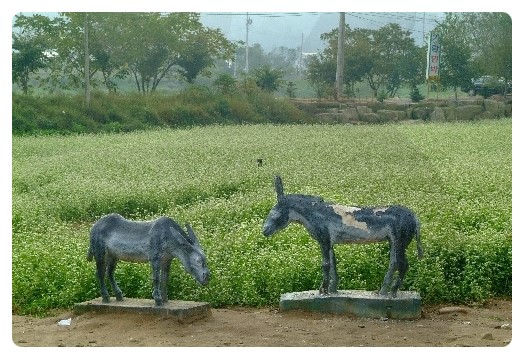
Bongpyeong, which is in Pyeongchang, Gangwon-do, is the background of ‘When Buck Wheat Flower is in Blossom’ and also the hometown of the author, Lee Hyo-seok. Designated as the first cultural village in 1990, this village is full of buck wheat flowers. Tourists stop by to see the mill and the bridge that appeared on the story.

There are many places reminding ‘When Buck Wheat is in Blossom’ in Bongpyeong. Firstly, let’s go to Lee Hyo-seok Culture Center. You will see everything from his life to work.

It displays his medals, remains, first published book, translated copies in English and Japanese, magazines and newspapers introducing his works. In addition, you can take a walk in a garden of literature, buck wheat flower road, and a small path.

You will find Lee’s birth place nearby. In his early years, it was a thatched-roof house, but later it was changed into a house with galvanized iron roofing during nation developing project,Saemaeul Movement and then into tile roofing. Fortunately, Pyeongchang-gun restored his house to the original one in 2007. The farming tools on the walls will make you feel being in the past.

<Bongpyeong, hometown of a renowned novel, ‘When Buck Wheat Flower is in Blossom’> (Source: Korea Tourism Organization)

Not far away from here, there is Gasan Park for commemorating him. Chungju pub was built nearby and his statue and the monument were placed in a sculpture square. Getting out of the park and crossing the Seob Bridge, Bongpyeong traditional market will be waiting for you. Every scene in the novel will be alive in front of you.

Pyeongchang has held Hyoseok Writing Contest since 1971 with respect to Lee Hyo-seokand his achievement. Soon after, in 1999, it was expanded to Hyo-seok Culture Festival so that everyone can participate. Every mid-September, tourists come to the festival. The themes of the festival are affection from novel, fragrance of nature, nostalgia of tradition.

Why don’t you go to Bongpyeong and see heartbreaking sceneries of all mountains and buck wheat?

Journey to ‘Eight Sceneries of Gwandong Region’

If you are Korean, you might remember this one. ‘Gwandongbyulgok’, a travel story. The lyrics used to appear in a textbook and a school exam. It is about a newly appointed governor,Jeongcheol’s impression on the beauty of Gangwon-do. He praises the breathtaking scenery of Mt. Geumgang and then tells what Chongseok pavilion and Samil beach are like from the east coast. The story continues as he headed to Euisang pavilion in Yangyang.


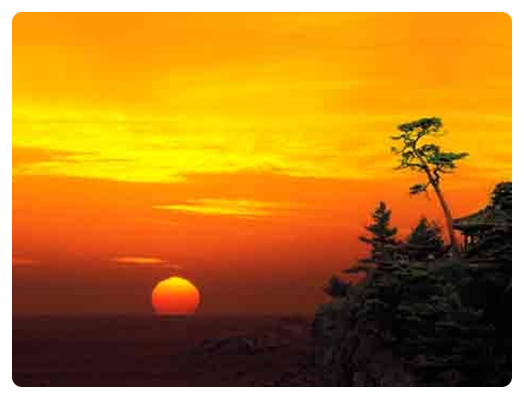
Euisang Pavilion> (Source: Korea Tourism Organization)

Naksan temple was founded by Buddhist priest, Euisang, in a reign of King Munmu. It is regarded as one of the three major Gwaneum temples. There is a legend that Euisang met Buddha Gwaneum at Naksan. Euisang pavilion is located on the cliff near the ocean. There are old pine tree named ‘Gwaneum’ around and a statue of Buddha Gwaneum on the hill.

East Sea seen from Euisang pavilion has many beautiful rocks and blue ocean. A lot of people come to see the sunrise like Jeongcheol described.

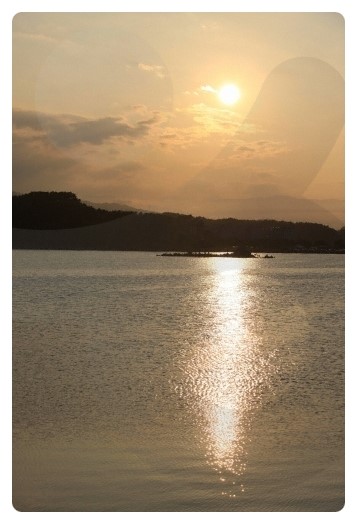
Finally, Jeongcheol arrived at Lake Gyeongpo where the fresh water and the ocean meet together. The lake was formed as the sand accumulated and eventually blocked the water route.

For that reason, the area got to have a beautiful soft sand beach, eastern coast and wide lake. Everyone easily forget how time flies when they face the wind breeze and appreciate the view from pavilion. Indeed, they are the truly magnificent sceneries.

Gyeongpo> (Source: Korea Tourism Organization)

Now, let’s go to the south. Nearby a beautiful river of Samcheok, there is Jukseoroo. Unlike the other Gwandong pavilions located around coast, this pavilion is on the cliff, which is special. Next, Jeongcheol arrived at Mangyang pavilion, which he chose as the last destination of his journey. At the end of the journey, Jeongcheol stood there and encouraged himself for coming future. The pavilion located on the most southern part of Korea received the sign board that says ‘Gwandongjaeillu’ from King Sukjong, which means the best pavilion in Gwandongarea. If you look at the ocean from there, you will understand why.

From September to October would be the perfect season to enjoy the full view of East Sea. If you love the ocean and car driving, this journey is the one you would love.

The Journey to Beolgyo, Site of Novel ‘Taebaksanmaek’

The novel ‘Taebaeksanmaek’ is considered one of the best sagas which deal with modern history of Korea. The story is about before-and-after war and the people. Since it is said that the novel would be dramatized, Bosung-gun Bulgyo, Jeollanam-do, the background of it, started to rise as a tourist attraction.

Bulgyo is the most crucial background of the novel. Still, it is an important place where the ocean and river meets together, and a traffic hub connecting Goheung, Bosung andSuncheon, which brings in many people.

All the mountains and fields are the background of ‘Taebaeksanmaek’, such as Baekdong village, Chudong Resovoir, Woeseo and Nakan. The railway, mountain valley, Rich family,Hyun’s mansion, Hong Bridge, small church and embankment which appeared in novel are still well preserved.

Jo Jeong-rae Taebaeksanmaek> (Source: Korea Tourism Organization)

If you see the area surrounded by mountains, you will recognize the place is just perfect to present the era of disturbance.

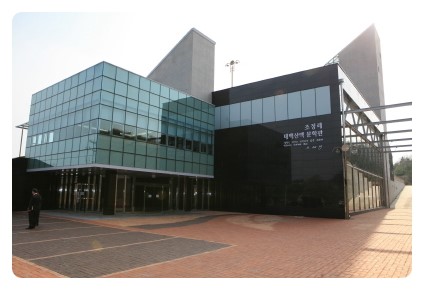
The literature center is near Sohwa’s house of the novel. It displays author’s notebook, camera and six-years of written note of writer Jo Jeong-rae which is taller than a grown-up man. The center also became famous since the novel got popular.

There are many places which were mentioned in the novel. Why don’t we go to Beolgyo to feel the great literature and the era of Korea?

Just for reading this, I think you already started the journey. Only the ones who get to the site of the novels can tell how exciting it is. Also it must be fun to think of how different it would be from what you have imagined of real sites.

Your journey with Korean literature will be more fun after going through the books again. Why don’t you start a trip to find out the sites of your novels?